
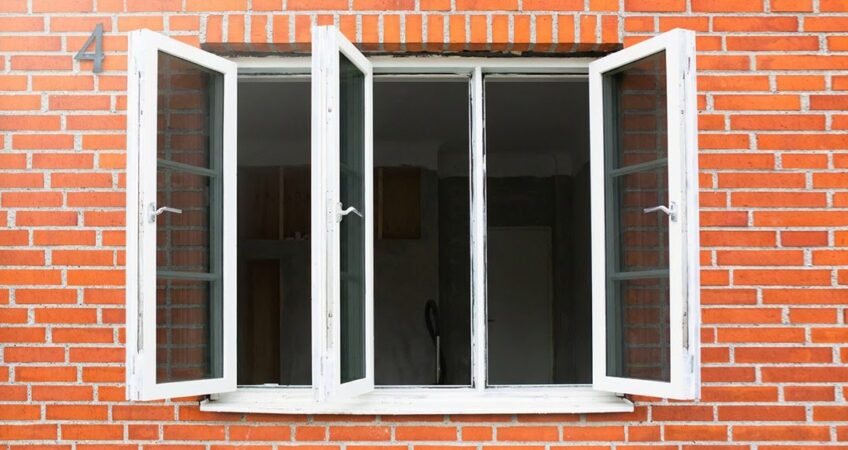
A double pane window is two sheets of glass held apart by a spacer and sealed around the edge, with argon gas filling the space between them. That sealed airspace is the whole point, because it slows the heat moving through the window, softens outside noise, and keeps the interior glass warm enough to resist the condensation that coats a single pane on a cold morning.
Below we cover what sits inside the sealed space, how the assembly actually slows heat, what the R-value means, how to tell whether your own windows are single or double pane, when the technology became standard, what a failed seal looks like, why fogged glass cannot be un-fogged, and how to decide between repairing and replacing.
What Is a Double Pane Window?
A double pane window is a window whose glass is built from two sheets separated by a sealed airspace, assembled and sold as a single sealed component. The industry calls that component an insulated glass unit, or IGU, and the same product goes by double glazed in much of the world.
The sealed part matters more than the two-pane part. An old storm window also puts two layers of glass in front of an opening, but the gap between them is open to outside air, so moisture and air currents move freely through it. A double pane unit is closed off at the perimeter, which traps a controlled volume of gas that cannot circulate.
Two panes and one sealed cavity make up the glass. The frame that carries the IGU is a separate matter, and vinyl, fiberglass, wood, and aluminum frames all accept double pane glass. That is why two windows can hold identical glass and still perform differently.
What Is Between Double Pane Windows?
Between the panes of a double pane window sit a spacer bar, a desiccant, an insulating gas fill, and a two-stage edge seal, with a Low-E coating applied to one of the interior glass surfaces. Five components, each with a job that fails visibly when it stops working.
The spacer sets the gap. Libbey-Owens-Ford’s insulated glass patent specifies a sealed airspace between 0.125 inch and 0.375 inch, and that range exists because the cavity has a performance sweet spot. Too narrow, and the panes conduct heat across to each other. Too wide, and the gas inside starts to circulate, carrying heat from the warm pane to the cold one.
Spacer material decides more than most homeowners realize. An aluminum spacer conducts heat straight around the edge of the unit, creating a cold band at the glass perimeter that shows up as edge condensation in winter. A warm-edge spacer built from stainless steel, foam, or structural polymer cuts that edge conduction sharply, which is one of the quiet reasons a modern unit outperforms a 1990s one carrying the same two panes. Our replacement windows use warm-edge construction as standard practice.
Inside the spacer bar sits the desiccant, a granular drying agent that absorbs any stray moisture sealed into the cavity at the factory. Desiccant capacity is finite, and that finite capacity becomes the whole story later in this article. Around the outside of the spacer, a two-stage seal holds everything together: a primary seal of polyisobutylene that blocks gas from escaping, and a secondary structural seal that bonds the assembly.
What Gas Is in Double Pane Windows?
The gas in most double pane windows is argon, with krypton used in units built for higher performance or narrower cavities. Both are inert noble gases, both are colorless, and both work for the same reason: density.
Argon is roughly six times denser than air, and krypton is roughly twelve times denser. Denser gas moves more sluggishly inside the cavity, which suppresses the convection currents that would otherwise ferry heat across the gap. Krypton earns its place in thin cavities, where its density lets a narrower airspace hit the same performance a wider argon-filled one would. The differences between gas fills come down to cavity width, target U-factor, and manufacturing cost.
Not every double pane window is gas filled. Older units and low-end assemblies use dehydrated air, which still insulates better than a single pane but gives up meaningful performance against an argon fill.
Are Double Pane Windows Vacuum Sealed?
No, double pane windows are not vacuum sealed. They are hermetically sealed and gas filled, which is a different construction entirely. A vacuum would need to be held against full atmospheric pressure pushing the panes together, and standard residential glass and spacers are not built to resist that load.
Vacuum insulated glazing does exist as a separate product category, using tiny support pillars between the panes to hold them apart under vacuum. It remains a specialty item rather than the standard residential window. When a manufacturer says sealed, they mean airtight against gas escape, not evacuated.
How Do Double Pane Windows Work?
Double pane windows work by interrupting all three ways heat crosses a window: conduction through the glass, convection inside the cavity, and radiation through the glass surface. Each component from the section above handles one of those three.
Conduction is blocked by the gap itself. Glass conducts heat readily, so a single sheet passes warmth straight from the warm side to the cold side. Splitting the glass into two sheets with gas between them forces the heat to cross a poor conductor on its way, and gas conducts far worse than glass does.
Convection is blocked by the gas density and the cavity width working together. Inside a sealed cavity, warm gas rises along the interior pane and cold gas sinks along the exterior pane, forming a loop that hands heat across the gap. Argon slows that loop, and holding the cavity inside the 0.125 to 0.375 inch band keeps the loop from developing much force in the first place.
Radiation is blocked by the coating. A microscopically thin metallic layer applied to one of the two interior glass surfaces reflects long-wave heat back toward whichever side it came from, and the coating is transparent to visible light, so the room stays bright. A Low-E coating is doing most of the radiant work in a modern unit. Without it, ENERGY STAR notes that a standard double pane window admits approximately 75 percent of the sun’s heat.
Why Are Double Pane Windows Better Than Single Pane?
Double pane windows are better than single pane windows because they cut heat transfer, reduce drafts, soften outside noise, resist interior condensation, and lower household energy bills, none of which a single sheet of glass can do. The gap between the two products is wider than the description suggests.
Energy is the headline. The U.S. Department of Energy reports that heat gain and heat loss through windows account for 25 to 30 percent of residential heating and cooling energy use, which makes glass the largest single weak point in most building envelopes. ENERGY STAR estimates that replacing single pane windows with certified windows lowers household energy bills by an average of up to 13 percent nationwide.
Comfort is the part people notice first. A single pane window runs close to outdoor temperature on its interior surface, and that cold surface pulls heat off anyone sitting near it, which is why a room can read 70 degrees on the thermostat and still feel chilly by the window. A double pane unit keeps the interior glass much warmer, and the cold spot disappears.
| Feature | Single Pane | Double Pane | Triple Pane |
|---|---|---|---|
| Panes of glass | One | Two | Three |
| Sealed cavities | None | One | Two |
| Approximate R-value | About R-1 | R-3 to R-5 | R-6 to R-9 |
| Gas fill | Not applicable | Argon or krypton | Argon or krypton in both cavities |
| Noise control | Minimal | Noticeable reduction | Strongest reduction |
| Interior condensation | Frequent in winter | Strongly resisted | Strongly resisted |
| Unit weight | Lightest | Standard | Significantly heavier |
| Best use | Legacy and historic openings | Most homes in most climates | Severe cold and high-noise sites |
Sources: Pella Corporation R-value ranges; ENERGY STAR residential window performance data; U.S. Department of Energy.
The environmental side follows the energy side. ENERGY STAR estimates that replacing single pane windows with certified units cuts household carbon emissions by 1,006 to 6,205 pounds per year, depending on the home and the local power mix.
What Is the R-Value of a Double Pane Window?
The R-value of a double pane window is approximately R-3 to R-5, compared with about R-1 for a single pane and R-6 to R-9 for a triple pane, based on the ranges Pella publishes. R-value measures resistance to heat flow, so higher is better.
Window manufacturers usually publish U-factor rather than R-value, and the two are inverses of each other. A window with a U-factor of 0.25 carries an R-value near 4. Lower U-factor means less heat escaping, so on that scale lower is better, which is the reverse of R-value and the reason the two numbers confuse people. The U-factor printed on the label describes the whole assembly, glass and frame together, not the glass alone.
Certification thresholds tell you where a given unit lands. ENERGY STAR Version 7.0, effective October 23, 2023, sets the Northern climate zone requirement at a U-factor of 0.22 or lower paired with a Solar Heat Gain Coefficient of 0.17 or higher, and the Most Efficient designation tightens the U-factor to 0.20 or lower.
Local requirements sit alongside those. A 2023 report from the Northwest Energy Efficiency Alliance found that the 2022 Oregon energy code already exceeded the window performance proposed for the 2024 IECC, with the code U-factor for climate zone 4C moving from 0.30 down to 0.28. Energy Trust of Oregon reports that replacing old windows with ENERGY STAR certified windows lowers household energy bills by an average of 12 percent nationwide. Reading the energy ratings before ordering is how a homeowner confirms a unit clears all three bars at once.
Climate shapes which number to chase. The Portland area is heating dominated with mild summers, so U-factor carries far more weight here than Solar Heat Gain Coefficient does, and a glass package tuned for a hot southern climate would be the wrong specification for this region.
Does Double Pane Glass Reduce Noise?
Yes, double pane glass reduces noise. The second sheet of glass and the sealed gas cavity together break the path that sound waves travel through a window, cutting the volume of traffic, aircraft, and neighborhood noise reaching the room. A single pane offers almost nothing by comparison.
Sound crosses a window by vibrating the glass. One sheet vibrates freely and passes that vibration straight through to the room air. Two sheets separated by a dense gas cavity break the transfer, because the second sheet has to be driven by gas rather than by direct contact, and dense argon is a poor transmitter.
Three variables move the result further. Asymmetric glass thickness, where the two panes are deliberately made different thicknesses, prevents both sheets from resonating at the same frequency. A wider cavity within the 0.125 to 0.375 inch band improves low-frequency performance. Laminated glass, which sandwiches a plastic interlayer inside one of the panes, damps vibration directly. Meaningful noise reduction in a house near a busy road usually comes from combining two of those three rather than from pane count alone.
Do Double Pane Windows Block UV?
Double pane windows block a substantial share of UV when the glass carries a Low-E coating, which is standard on ENERGY STAR certified units. The metallic layer that reflects long-wave heat also reflects a large portion of ultraviolet radiation, and less UV entering the room means slower fading on hardwood floors, rugs, artwork, and upholstery. Clear double pane glass without a Low-E coating blocks far less.
How Do You Tell If a Window Is Single or Double Pane?
You tell if a window is single or double pane by inspecting the glass edge for a spacer, running a reflection test, checking the sash for an NFRC label, and looking for a manufacture code stamped into the spacer bar. Four checks, each faster than the one before it fails.
The glass looks identical from across a room, which is why the question comes up so often. Up close, the construction gives itself away. Work through these in order:
- Open the sash and look straight down at the edge of the glass. A double pane unit shows two distinct sheets with a metal or composite spacer bar running between them. A single pane shows one sheet and no spacer.
- Hold a small light source near the glass at an angle and count the reflections. Two panes throw four reflections, since each sheet reflects from both of its faces. One pane throws two.
- Check the sash frame, the jamb, and the lower corner of the glass for an NFRC label or an etched logo. Insulated units are rated and labeled; bare single panes generally are not.
- Look along the spacer bar itself for a stamped code. Manufacturers frequently print a build date or a plant identifier there, which confirms the unit is insulated and tells you roughly how old the glass is.
Step four is the one most homeowners skip, and it is the most useful, because a date on the spacer answers the age question that drives every decision later in this article.
What Year Did Double Pane Windows Become Standard?
Double pane windows became standard in American residential construction through the late 1970s and 1980s, roughly four decades after the technology was first patented and mass produced. Energy codes written after the oil shocks of the 1970s are what pushed insulated glass from an upgrade into a baseline.
The invention predates the adoption by a long stretch. Thomas D. Stetson filed the first U.S. patent for an insulated glass unit in 1865, recognizing that replacing the humid air between two panes with dry air would slow heat loss. The idea sat unused in the building trades for roughly seventy years.
Commercial production arrived in the 1930s. Charles D. Haven, a refrigeration engineer, announced his sealed double glazed unit in Architectural Record in 1932, filed the Thermopane patent on October 12, 1934, and received the grant in 1936. Haven sealed the perimeter with rubber strips and dehumidified the trapped air rather than filling it with an inert gas, which was the technical limit of the era. Libbey-Owens-Ford partnered with Haven in the late 1930s to mass produce the units, and insulated glass spread through American construction across the 1950s and 1960s.
Age of the house is therefore a strong predictor. A home built before roughly 1975 very likely started life with single pane glass, whether or not it still has it. A home built after the mid-1980s almost certainly started with double pane.
What Is the Average Lifespan of a Double Pane Window?
The average lifespan of a double pane window is governed by the edge seal rather than by the glass or the frame, and a well-built modern unit holds that seal for decades before performance declines. Glass does not wear out. Seals do.
Seal life is a materials problem that Haven identified from the beginning. He recognized that the interior and exterior sheets expand and contract at different rates as temperatures swing, and that the resulting strain works against the bond between the glass and the spacer. Every insulated unit built since has been an answer to that same problem, and modern polyisobutylene and structural sealants answer it far better than 1930s rubber strips did.
Gas retention declines gradually alongside the seal. Argon diffuses out of the cavity slowly over the life of a unit even when the seal remains intact, so a twenty-five-year-old window carries less gas than it left the factory with, and its U-factor has drifted upward accordingly. That drift is invisible, which is why an older window can look fine and still cost money every month.
Frame material and installation quality set the outer boundary. A sealed unit installed in a rotting sash or an out-of-square opening carries stress it was never designed for, and stressed seals fail early.
What Happens When a Double Pane Window Fails?
When a double pane window fails, the edge seal breaches, the argon fill escapes, humid outside air enters the cavity, the desiccant saturates, and moisture begins condensing between the panes where nothing can reach it. That sequence is one-directional and it does not reverse.
The breach comes first and shows no symptom. A crack in the primary seal is invisible, and the only immediate consequence is that the gas fill starts leaving. Once the argon is gone, the cavity holds ordinary air, and the unit’s R-value falls back toward what two sheets of glass and an air gap can manage on their own.
Desiccant saturation comes second and produces the visible symptom. Outside air carries water vapor into the cavity with every pressure and temperature swing, and the drying agent inside the spacer absorbs that vapor until it reaches capacity. A saturated desiccant no longer absorbs anything, so the next batch of humid air has nowhere to give up its moisture except onto the cold interior face of the glass.
Mineral staining is the final stage. Water that condenses and evaporates repeatedly inside the cavity leaves behind dissolved solids, which etch a permanent haze into the glass surface. At that point the glass itself is damaged, not just clouded. Recognizing seal failure before it reaches staining gives a homeowner more options.
How Do You Tell If Double Pane Windows Are Bad?
You tell if double pane windows are bad by looking for moisture, haze, or distortion trapped between the two panes, where no cloth can reach it. Fog that appears on humid days and clears on dry ones points to an early-stage breach. A permanent milky film points to mineral staining and a late-stage one. Two other signals matter: a cold band around the perimeter of the glass in winter suggests spacer conduction or a failing edge, and glass that suddenly feels colder than the other windows in the same wall suggests the gas fill has gone.
Why Do Double Pane Windows Fog Up?
Double pane windows fog up because the edge seal has failed and humid air has entered the sealed cavity, where it condenses on the inner glass surfaces as temperatures change. Fog between the panes is always a seal problem, never a cleaning problem.
The fog behaves on a daily cycle at first. Moisture in the cavity condenses when the exterior pane cools below the dew point of the trapped air, usually overnight or early in the morning, then evaporates back into the cavity as the sun warms the glass. That come-and-go pattern is the earliest reliable sign, and it often runs for a season or two before the fog becomes permanent.
Location within the glass tells you the same story from another angle. Fog appearing first at the bottom edge of the unit reflects the fact that the coldest, dampest air in the cavity settles there, and the bottom of the spacer is where seal stress concentrates.
Should Double Pane Windows Have Condensation?
Double pane windows should not have condensation between the panes, and that location always indicates a failed seal. Condensation on the interior surface of the glass, on the room side, is a completely different matter and is usually not a window defect at all. Condensation on the exterior surface, on the outdoor side, is actually a sign of good performance, because it means the outer pane is staying cold rather than being warmed by heat escaping the house.
Why Do Double Pane Windows Sweat on the Inside?
Double pane windows sweat on the inside because indoor humidity is high enough that room air reaches its dew point against the coolest surface available, which is the glass. The window is reporting a humidity level, not announcing a defect. Showers, cooking, laundry, unvented gas appliances, houseplants, and simple occupancy all push indoor moisture up, and a tightly built house holds that moisture longer than a leaky one does.
Newberg homes see this every wet winter, and the diagnosis is nearly always the same. The fix works on the air rather than the glass: run bath and kitchen exhaust fans during and after use, keep interior doors open so air circulates, and bring indoor relative humidity down. Reducing indoor humidity resolves interior sweating in most houses without touching the windows. ENERGY STAR notes that certified windows keep the interior glass surface warmer, which raises the threshold at which sweating begins in the first place.
Can a Double Pane Window Be Repaired Without Replacing It?
A double pane window can sometimes be repaired without replacing the whole unit, but only by swapping the insulated glass while keeping the existing frame and sash, and only when the frame and sash are still sound. The glass gets replaced either way; the question is how much comes out with it.
Defogging services deserve a clear-eyed look, because they are widely advertised and widely misunderstood. The process drills the glass, flushes and dries the cavity, then fits a small vent. It removes the visible fog. It does not restore the argon fill, does not restore the original U-factor, does not restore the hermetic seal, and leaves the cavity permanently open to outside air. Cosmetically it works. Thermally the unit stays where it was.
Resealing a failed unit in place is not a realistic option either. The primary seal is applied inside a controlled factory environment before the panes are joined, and it cannot be reached, cleaned, or re-bonded once the assembly is built and installed.
That leaves two honest paths. Insulated glass replacement pulls the failed IGU and fits a new one into the existing sash, which suits a house with sound frames, square openings, and a small number of failed units. Full window replacement makes more sense when the frames have deteriorated, the sashes no longer seal, the openings have shifted, or enough units have failed that the labor of doing them one at a time outweighs the difference. We assess frames, sashes, and openings before recommending either, because fitting new windows into a compromised opening wastes the performance you paid for.
Can You Clean Between Double Pane Windows?
No, you cannot clean between double pane windows. The cavity is sealed shut at the factory and has no access point, which is exactly the property that makes it work. Any haze visible in that space came from a seal failure, and it is either suspended moisture or mineral residue etched into the glass. Neither responds to cleaning, and both call for the glass to be replaced.
Are New Double Pane Windows Better Than Old Ones?
Yes, new double pane windows are better than old ones. Coating technology, spacer construction, sealant chemistry, and gas fill have all advanced enough that a current unit outperforms a 1990s unit carrying the same two panes of glass. The pane count stayed the same while everything around it improved.
Coatings improved the most. Early Low-E was a single silver layer. Current coatings stack multiple layers, which reflects more heat while passing more visible light, so a modern unit is both warmer and brighter than its predecessor.
Spacers changed almost as much. Aluminum was the default for decades, and it conducted heat around the glass edge at a rate that dragged down the whole-unit rating. Warm-edge spacers cut that path, improving both the U-factor and the resistance to edge condensation.
Certification thresholds document the shift. The Northwest Energy Efficiency Alliance reported that ENERGY STAR Version 6, in place since 2017, required a U-factor of 0.27 or lower, and that 84 percent of windows sold in the Northern zone met or exceeded it, which is part of why Version 7.0 tightened the requirement to 0.22. A window built to the older standard is a compliant, functioning window that simply no longer represents current performance.
Is It Worth Replacing 25 Year Old Windows?
Replacing 25 year old windows is worth it when the seals have failed, the gas fill has drifted out, the frames or sashes have deteriorated, or the energy penalty has grown large enough to matter month after month. Age alone is not the deciding factor. Condition and performance are.
Several factors point toward replacement rather than waiting:
- Fog, haze, or mineral staining visible between the panes on one or more units
- Glass that feels distinctly colder than other windows in the same wall, which suggests the gas fill has gone
- Sashes that stick, rattle, or no longer compress against the weatherstripping
- Rot, swelling, or soft spots in wood frames and sills
- A cold draft you can feel with a hand held near the sash on a windy day
- Heating bills climbing year over year with no change in rates or occupancy
Resale carries part of the return. The Remodeling Cost vs. Value Report puts vinyl window replacement at roughly 68.5 percent of project cost recovered at resale and wood window replacement at roughly 61.2 percent, and the rest of the return accrues in energy and comfort while you still live there. Watching for signs of wear early keeps the decision on your timeline rather than an emergency one.
Are 20 Year Old Windows Still Good?
Twenty year old windows are still good if their seals are intact, their sashes close tightly, and their frames are sound. Run the fog check and the cold-glass check on every unit before drawing a conclusion, because failure rarely arrives across a whole house at once. A house frequently holds a handful of failed units alongside twenty perfectly serviceable ones, and identifying which is which is the first step in any sensible plan.
Is There Something Better Than Double Pane Windows?
Yes, there is something better than double pane windows for certain homes: triple pane glass, which adds a third sheet and a second sealed cavity to reach roughly R-6 to R-9 against double pane’s R-3 to R-5. Better on paper does not automatically mean better for a given house.
The trade-offs are real. Pella reports that triple pane units run approximately 10 to 15 percent more than comparable double pane configurations, and the third sheet of glass adds significant weight, which affects hardware, frame depth, and installation on large or upper-floor openings.
Climate decides most of it. Triple pane earns its keep in severe cold, where heating runs long and hard, and near highways, airports, and rail lines, where the extra mass and second cavity deliver meaningful sound control. In a mild marine climate with short heating seasons, a well-specified double pane unit already clears code and certification thresholds comfortably.
Noise is the exception worth weighing on its own. A house on a busy arterial or under a flight path can justify the upgrade for sound alone, regardless of climate. Comparing triple pane against a high-performance double pane package is the right conversation to have before ordering, and for most homes in this region a strong double pane specification wins on value.
Numbers settle it better than assumption does. We put the two glass packages side by side on every window replacement quote, with the U-factor, the R-value, and the weight of each unit written out.
Frequently Asked Questions
Can You Tint Double Pane Windows?
You can tint double pane windows, but doing so carries risk that homeowners should weigh first. Aftermarket film applied to the interior surface absorbs heat that the glass was not engineered to hold, and the resulting thermal stress can crack the pane or strain the edge seal. Many manufacturers void the glass warranty when film is applied. A Low-E coating built into the unit at the factory delivers similar solar control without either problem.
Is Double Pane Glass Safety Glass?
Double pane glass is not automatically safety glass. Pane count and glass treatment are separate specifications, and a standard insulated unit uses annealed glass in both sheets. Building codes require tempered or laminated safety glass in specific locations, including glass in and adjacent to doors, glass near floor level, glass in bathrooms near tubs and showers, and glass close to stairways. Those units are built with safety glass because the code demands it, not because they are double pane.
Should Double Pane Windows Feel Cold?
Double pane windows should feel cool to the touch in winter but never cold, and they should not feel noticeably colder than the other windows in the same wall. Glass will always run cooler than a wall, since glass insulates far less than framed and insulated construction does. A single unit that reads distinctly colder than its neighbors usually indicates a lost gas fill or a failing seal.
Which Window Glass Is Best for a Home?
The best window glass for a home in a heating-dominated climate is a double pane, argon-filled unit with a Low-E coating and a warm-edge spacer, specified to a U-factor of 0.22 or lower. That combination meets the ENERGY STAR Version 7.0 Northern zone threshold and clears local code with room to spare. Laminated glass is worth adding on street-facing rooms where noise is the priority.
How Do You Clean Double Pane Windows?
You clean double pane windows the same way you clean any window, working only on the two exposed outer surfaces with a mild glass cleaner or a dilute vinegar solution and a microfiber cloth or squeegee. Avoid abrasive pads and ammonia-heavy products near the sash, since both can damage the coatings on the exposed surfaces and degrade the seals around the perimeter. Clean on an overcast day so the solution does not dry into streaks before you can wipe it.
Can You Add a Second Pane to a Single Pane Window?
You cannot add a second pane to an existing single pane window and produce a true insulated glass unit, because the hermetic seal and the gas fill are created at the factory before the panes are joined. Interior storm panels and insulating window film both improve a single pane’s performance and both remain useful where full replacement is not practical. Neither delivers the sealed cavity that gives a genuine double pane unit its rating.
The Bottom Line
A double pane window is two sheets of glass sealed around a spacer with argon between them, and every part of its performance traces back to that sealed cavity staying sealed. The spacer sets the gap, the gas slows convection, the Low-E coating reflects radiant heat, the desiccant absorbs stray moisture, and the edge seal holds the whole arrangement together. Together they deliver roughly R-3 to R-5, noticeably quieter rooms, and glass that stays warm enough to resist winter condensation.
When that seal breaks, the fog you see is the last step in a sequence that started invisibly, and no cleaning or defogging process puts the argon back. Checking your own glass for a spacer, a date stamp, and a fog pattern tells you which situation your house is in, and that answer drives everything else. Our showroom sits in Newberg and consultations are available by appointment.
Anyone at EnergyGuard Windows & Doors is glad to look at a foggy unit and tell you plainly whether the glass or the whole window needs to come out.
Book a free consultation whenever you want a second set of eyes on it.